
In a world where digital transformation seems to have absorbed everything, printed paper has shown surprising resilience. However, its role has shifted: it is no longer just a static carrier of information, but a physical interface device. For modern companies, true innovation does not lie in choosing between paper or digital, but in mastering omnichannel strategies.
Below, we analyze the three technologies turning printed material into intelligent, connected tools.
1. The QR Code Renaissance: From Convenience to Conversion
After years of limited use, the QR code has established itself as the gold standard for quick connectivity. But for a business, its value goes far beyond saving a user from typing a URL.
- Dynamic Marketing and Retargeting: By using dynamic QR codes, companies can change the link destination without needing to reprint the material. Furthermore, they allow for the insertion of tracking pixels to retarget digital ads to those who scanned the physical brochure.
- Security and Authentication: In the printing of official documents or premium product labels, encrypted QRs allow for the verification of an item’s authenticity in seconds, protecting intellectual property and customer trust.
- Frictionless Experience: Native integration in all current smartphone cameras has removed the barrier to entry, making it the most democratic method of interaction.
2. NFC Technology: The Sophistication of “Contactless”
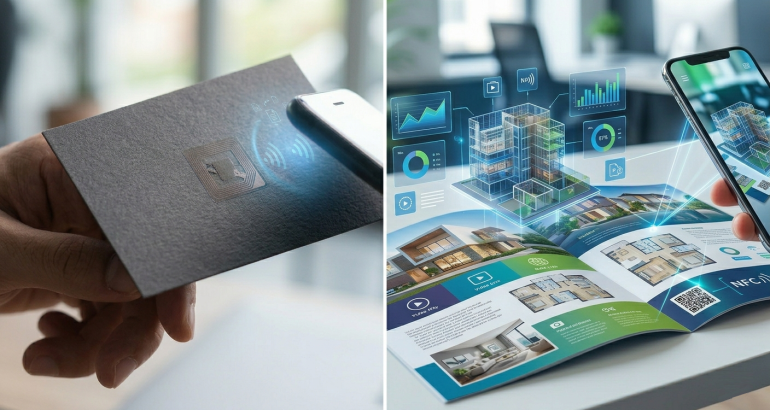
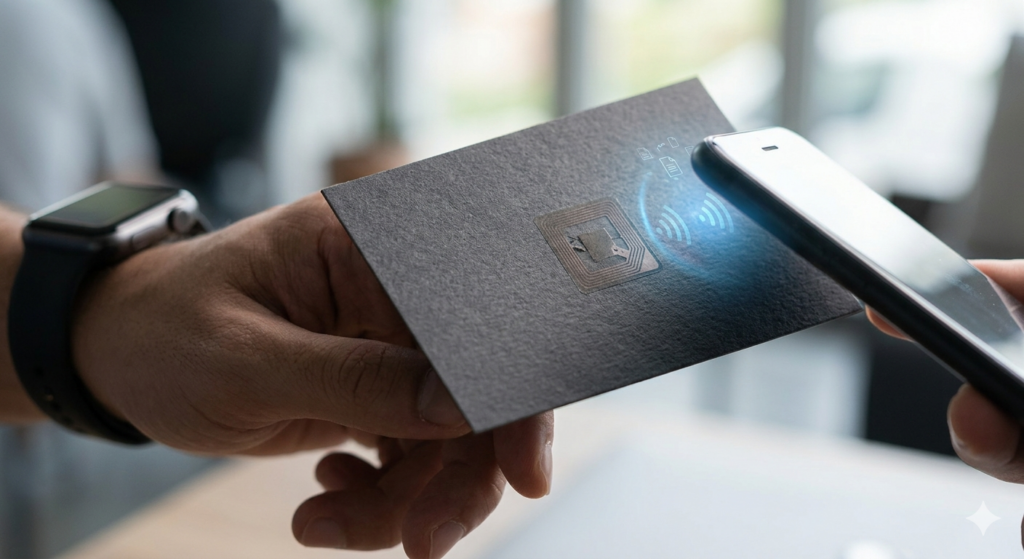
NFC (Near Field Communication) is the technology behind mobile payments, and its application in printed paper is synonymous with exclusivity and efficiency. Unlike QR codes, NFC does not require direct line-of-sight; it works by proximity.
- Smart Business Cards: A single card can instantly transfer your LinkedIn profile, portfolio, and contact details directly to a client’s phone with a single tap.
- Process Automation (Smart Labels): In industrial or office environments, an NFC tag on a printer can automatically launch a technical support ticket or place a toner order when a user brings their device close.
- High-End Interaction: Luxury brands use NFC chips embedded in textured paper catalogs to offer an experience that feels “magical,” removing the “point and shoot” step of the camera.
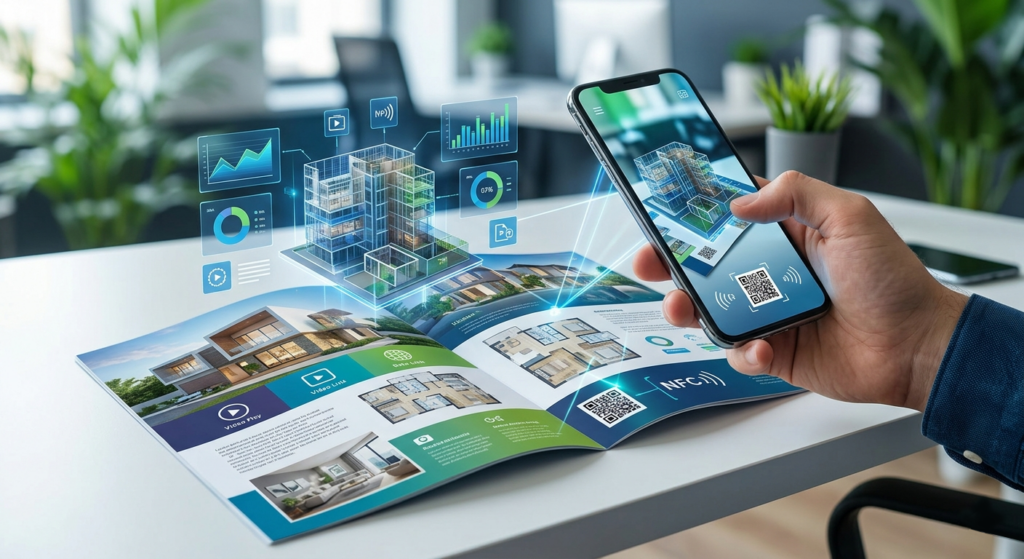
3. Mixed and Augmented Reality: Paper as an Interactive Canvas
Mixed Reality (MR) is perhaps the most spectacular frontier. Here, the printed material acts as a “marker” that software recognizes to overlay digital layers of information in real-time.
- Architectural Project Visualization: A 2D floor plan rises off the table as a 3D model when viewed through a tablet or smart glasses, allowing clients to explore structures before they are built.
- Training and User Manuals: Instruction manuals come to life. Instead of reading complex diagrams, the user sees animations over the actual machine indicating exactly which part to move or which button to press.
- Retail Gamification: Interactive catalogs allow users to “try on” products or see how a piece of printing equipment would fit in their actual office space (AR Placement), accelerating the purchase decision cycle.
Conclusion: The Future is “Phygital”
The integration of QR, NFC, and Mixed Reality into printed material is not just an aesthetic trend; it is a data capture strategy. For the first time in history, companies can measure the Return on Investment (ROI) of a printed campaign with the same precision as a Google Ads campaign.
At Total Prints Solutions, we understand that smart paper is the bridge that unites the tangibility of your brand with the analytical power of the digital world. It is time to stop printing static documents and start printing interconnected experiences.